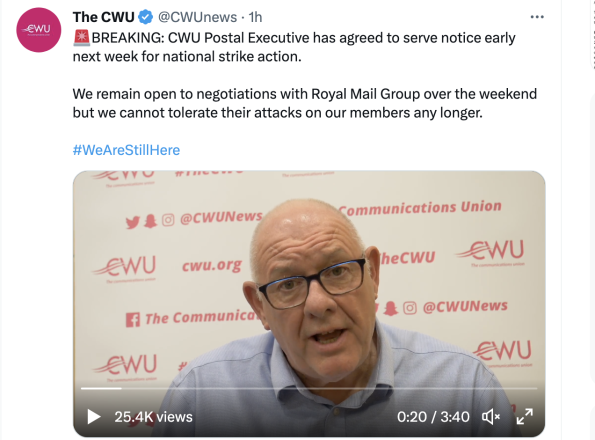
Communication Workers Union (CWU) general secretary Dave Ward has announced, in a video message to members on Friday 24 March, that the union’s postal executive has agreed to serve notice for further strikes in Royal Mail “early next week”.
The CWU secured a huge mandate for further industrial action in its most recent ballot but has held back from calling further strikes to pursue talks with Royal Mail. A joint statement between Royal Mail and the CWU, setting out the parameters for those talks, indicated workplace CWU reps would be expected to engage in local consultation over how Royal Mail’s proposed changes could be implemented.
Ward’s message said that, although he understood postal workers’ frustration about changes Royal Mail was already imposing, workers would realise worse had been held back “if [they] could see” other intended changes Royal Mail had revealed in talks. He also said the CWU would not “shirk change”, and that the union might have to accept “changes that not everyone will like.”
Ward stressed the importance of pushing back a culture of overbearing, bullying management, and especially of targeted campaigns of disciplinary victimisation against union reps.
Although it is positive that CWU now intends to return to action, the direction of the dispute poses questions about the relationship between rank-and-file union members and the union’s leadership. Ward and other leaders pose matters in terms of workers needing to “support their union”, rather than emphasising the union as the expression of workers’ own collective organisation and power. Although any national dispute in a union with a centralised structure involves some degree of “top down” direction, disputes where the strategy is determined wholly or largely from above, with rank-and-file workers trained to see their role as loyal foot soldiers who “support their union” by carrying out its leadership’s instructions, are rarely successful.
Long breaks between rounds of action also allow employers to seize momentum and establish “facts on the ground” by imposing changes and victimising reps, forcing the union into an ever more defensive stance as it has to strike merely to regain ground lost during the cost of the dispute, rather than to pursue positive demands.
Winning the dispute now will require a significant escalation of action, possibly to an indefinite strike. Building support for that strategy amongst rank-and-file postal workers means ensuring they feel like they are driving their own dispute, rather than simply following orders. A significantly expanded system of hardship payments will also be needed to support members through sustained or indefinite action.